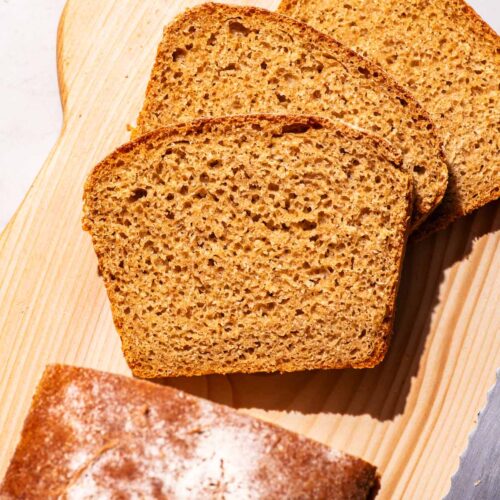
Einkorn Bread
Prep Time: 10 minutes
Cook Time: 45 minutes
Rising Time 1 hour 30 minutes
Total Time: 2 hours 25 minutes
Servings: 12
Description
Flavourful 100% whole grain einkorn bread, made using yeast. This simple ancient grain bread is a great lower-gluten staple loaf. It makes ideal toast bread and is very much in line with the type of bread you'll find in German bakeries, especially organic ones.
Ingredients
- 300 ml (1 ¼ cups) water room temperature
- 2 ¼ teaspoon dry yeast (1/2 cube fresh)
- 3 tablespoons olive oil
- 1 tablespoon honey
- 500 to 550 grams (~3 ⅔ cups) einkorn flour
- 1 teaspoon sea salt
Instructions
- Add the water to a large mixing bowl. Add the yeast, oil, and honey, and whisk to combine.300 ml (1 ¼ cups) water, 2 1/4 teaspoon dry yeast, 3 tablespoons olive oil, 1 tablespoon honey
- Add about a third of the flour to the bowl and mix to combine. Add the remaining flour and salt, and stir until a shaggy dough forms.500 to 550 grams (~3 ⅔ cups) einkorn flour, 1 teaspoon sea salt
- Cover the dough for ten minutes and let it rest before kneading. This allows the whole grains to absorb some of the water and makes the dough easier to work with.
- Turn the dough out onto a lightly floured surface and knead, adding a sprinkling of flour when needed (don't add too much). After about six minutes, the dough should be soft and smooth. Don't over work it. This can be done in a standing mixer, kneading for about four to five minutes on low speed.
- Place the kneaded dough back into the mixing bowl and cover with a tea towel and large plate. Set aside to rise until doubled, about an hour at room temperature.
- Punch the dough down and turn it out onto a lightly floured surface. Gently press it into a rough rectangle (the short edge should be the length of your bread tin). Make sure the dough isn't sticking to the work surface, then roll it into a tight spiral.
- Line a bread tin with parchment paper, or grease with a light-tasting oil or butter. Pictured is a 26cm (10 in.) long dish and is the perfect size for this recipe.
- Place the dough seam-side down into the prepared bread tin. Cover and set aside to rise again until puffy but not doubled, about half an hour.
- While the dough is rising, preheat the oven to 180°C (350°F).
- Once fully proved, bake the bread for 40-45 minutes, or until golden brown. If it's browning too much for your preference, cover loosely with foil or a piece of parchment paper. You can check the interior temperature with a thermometer (it should be 90°C or about 190°F when baked). For a softer loaf, brush the top with butter or coconut oil as soon as it comes out of the oven.
- Cool the loaf for ten minutes before removing from the tin and cooling fully on a wire rack. Keep in an airtight container or wrap well to store. Einkorn bread freezes well.
Video
Notes
I highly recommend using gram measurements for this recipe for accuracy. If using cups, be sure to go by feel and start with a lower amount of flour, working your way up bit by bit while kneading.
For a slightly lighter bread, replace a portion of the einkorn flour with light spelt flour. I find 200 grams of light spelt and 300 grams of einkorn to be a good balance.
Update February 2026: I retested this recipe and have altered the amount of flour to reflect that it is sometimes better with a slightly lower amount depending on the hydration capability of the flour used, the humidity, the time of year, and so on. The loaf pictured was made with 500 grams of flour but at other times of year and in other places I have used the full 550 grams.
Check your yeast: if you’re not sure if the yeast you’re using is still active, wait about 15 minutes after step one. If the mixture hasn’t bubbled up, you need new yeast.
Storage: keep the cool loaf in a sealed container (I use a heavy lidded pot) for the best results. It will keep for 2-3 days at room temperature but, like most yeast breads, is best fresh.
Freezing: this freezes well either in individual slices or the full loaf. Slices can be toasted directly from the freezer but to thaw a whole loaf I recommend wrapping in a tea towel until thawed to avoid soggy bread.
Nutrition
Calories: 228kcal | Carbohydrates: 36g | Protein: 7g | Fat: 5g | Saturated Fat: 1g | Polyunsaturated Fat: 0.4g | Monounsaturated Fat: 3g | Sodium: 201mg | Potassium: 23mg | Fiber: 7g | Sugar: 1g | Vitamin C: 0.02mg | Calcium: 2mg | Iron: 2mg
Nutrition is provided as a courtesy and is an estimate. If this information is important to you, please have it verified independently.