

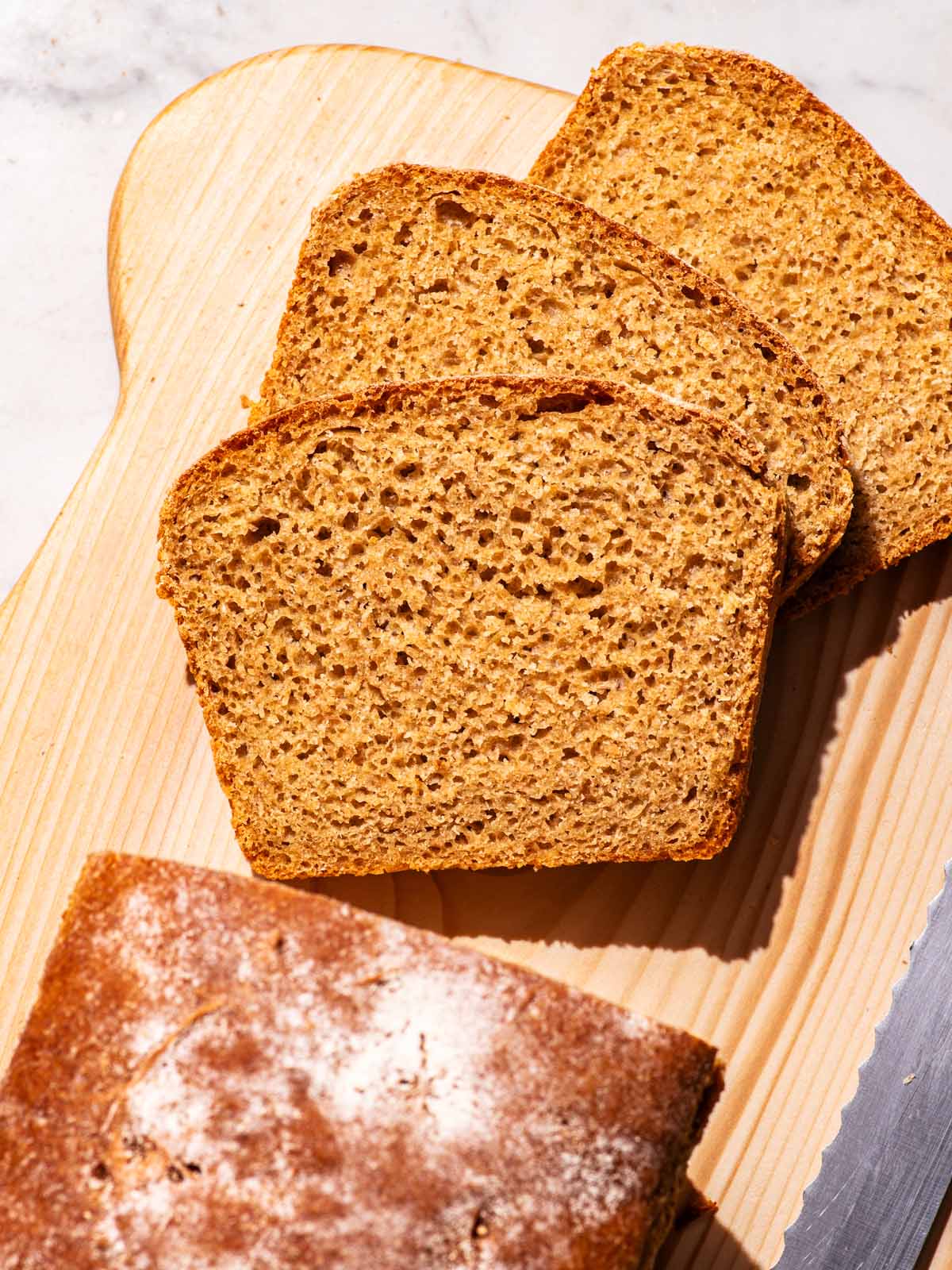
100% Whole Grain Einkorn Bread
Einkorn is one of the earliest cultivated wheats and what’s referred to as an ancient grain, like spelt, rye, khorasan, and emmer, among others. It was commonly used to make bread in parts of northern Europe for several hundred years, and remains a popular ingredient in German bakeries today.
This is a lower-gluten bread, which has some caveats, so be sure to read through all of the notes and instructions before beginning. If you’re used to baking with white flour it’s a rather different process and end result. I use both store-bought flour and home-milled flour for this recipe and it works well with both. The key is to measure with grams (never cups) and go more by feel.
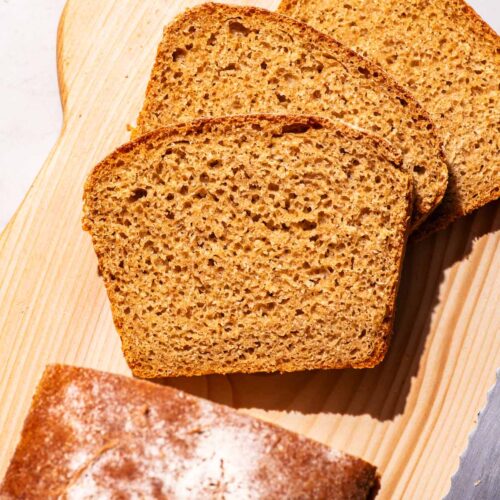
The resulting 100% einkorn bread is, of course, delicious and flavourful. The crumb is slightly denser than spelt – more similar to rye bread – and makes a good toast. This is adapted from my simple spelt bread recipe. All of the bread recipes on Occasionally Eggs are made exclusively with ancient grains.

I first shared this recipe in 2022. It’s been updated with improvements to the recipe instructions and slight improvements to the recipe (explained below), new clearer photos, and more helpful information. Please note that the video is the same.
I don’t use affiliate links. Any links you see here are to other recipes or related information, not paid links.
One reader, Jessie, commented: “Worked like a charm! Other than using maple syrup instead of honey, I followed the recipe exactly. Spraying my stoneware loaf pan with oil worked well (instead of parchment paper). One more thing: this recipe worked MUCH better for me than Jovial’s bread machine recipe for 100% whole grain einkorn.”
Another reader, S, said: “First time making bread, and it came out perfectly. Thank you for sharing your recipe.”
Ingredients You’ll Need and Why
This is a yeast recipe. If you want to use starter, use this sourdough einkorn bread recipe instead of trying to adapt this one. These are my notes from recipe testing, and you can find the full recipe card below with complete measurements and instructions.
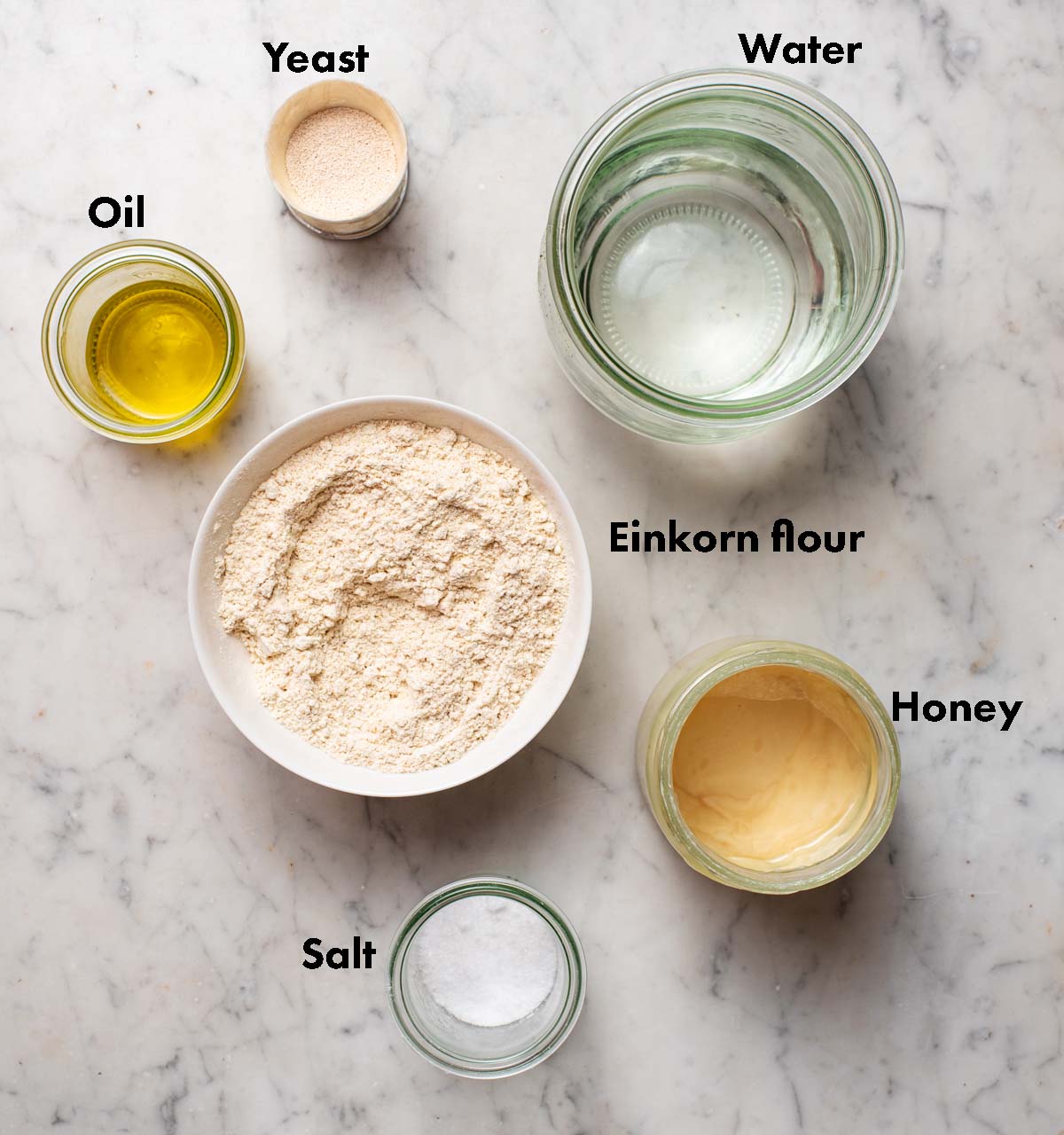
- Einkorn flour: as mentioned, this is made with whole grain flour. Sifted should be fine in the same quantities but I haven’t tested with it. I sometimes use store-bought flour and more often mill my own, and it’s good with either. Note that I’ve only tested this with European einkorn and there might be some slight differences with grain grown in other regions.
- Yeast: the yeast is added to the liquid ingredients, so any type will work (traditional, quick, instant, fresh) but if using instant it can be added with the flour and note that rising times will probably be slightly shorter.
- Salt: I only ever use fine grain sea salt. Coarse salt can cause an uneven rise unless fully dissolved in the water before mixing the dough and I recommend fine salt. Reducing or increasing the amount will change the rise and structure of the bread.
- Honey: sub maple syrup for a fully vegan bread if needed. Sugar can be used in an equal amount if preferred.
- Oil: I usually use olive oil, but any oil that’s liquid at room temperature will work. Melted butter is fine but the loaf is very slightly denser with butter.
How to Make Einkorn Bread
This is a short-rise loaf with a standard amount of yeast, and should be kneaded with a machine or by hand. Ancient grain bread is kneaded for a shorter time than standard wheat loaves because it contains less gluten.
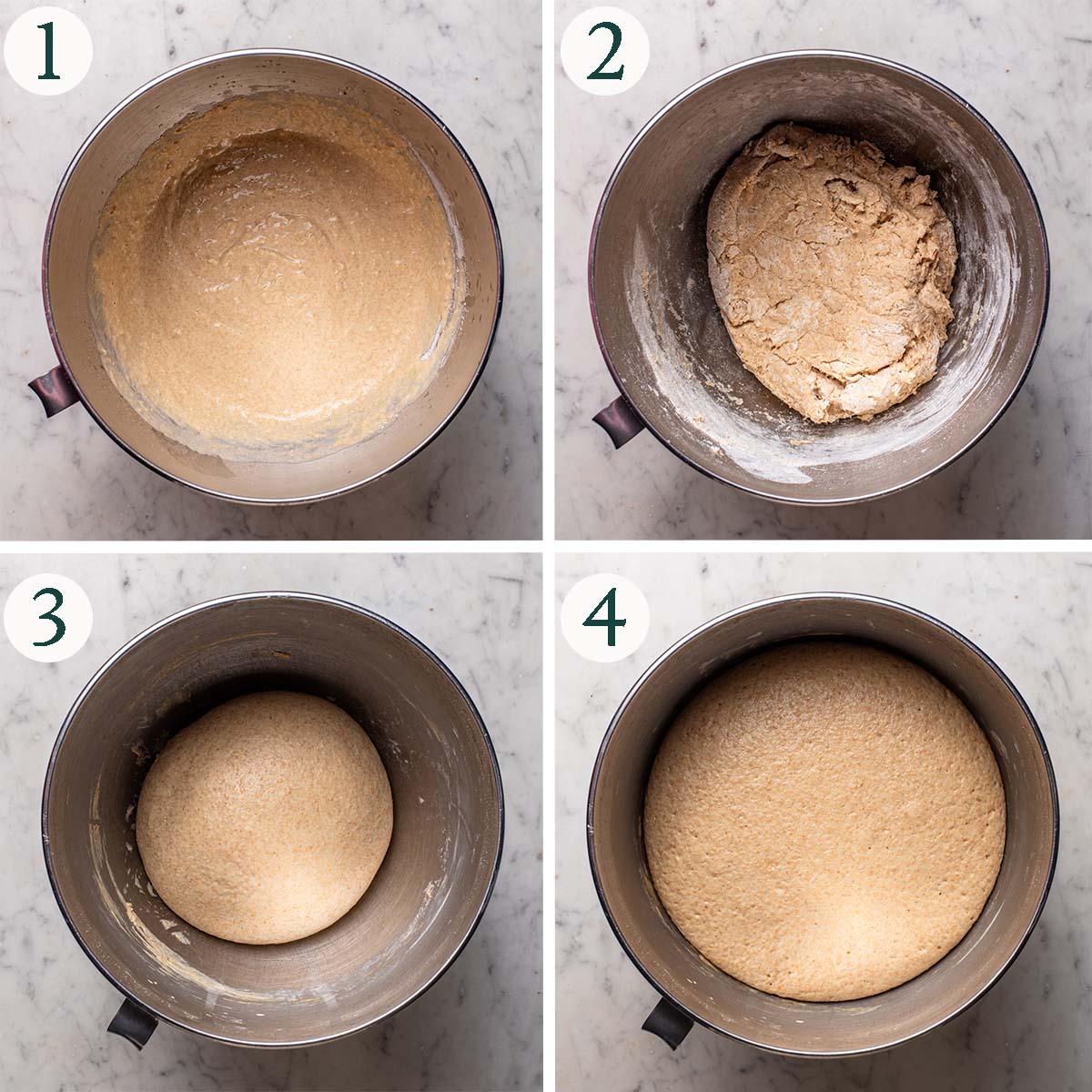
Step 1: mix the water, honey, and yeast, then add part of the flour and whisk to combine. Adding some flour initially helps with dough hydration.
Step 2: add the remaining flour (using less if using cups, and starting with 500 grams) and mix into a shaggy dough. It will be less sticky at this point than a white flour dough. Let this rest for ten minutes to hydrate. If you skip the resting time, the dough will be hard-pressed to form a smooth, supple dough when kneaded.
Step 3: knead the dough until soft and smooth. It will be slightly sticky even when fully kneaded, but less sticky when proved and you’ll handle it with flour when shaping.
Step 4: set the dough aside to rise until doubled in size, about an hour. This dough over-proves quickly so keep an eye on it if rising in a warmer place, even the oven with the light on.
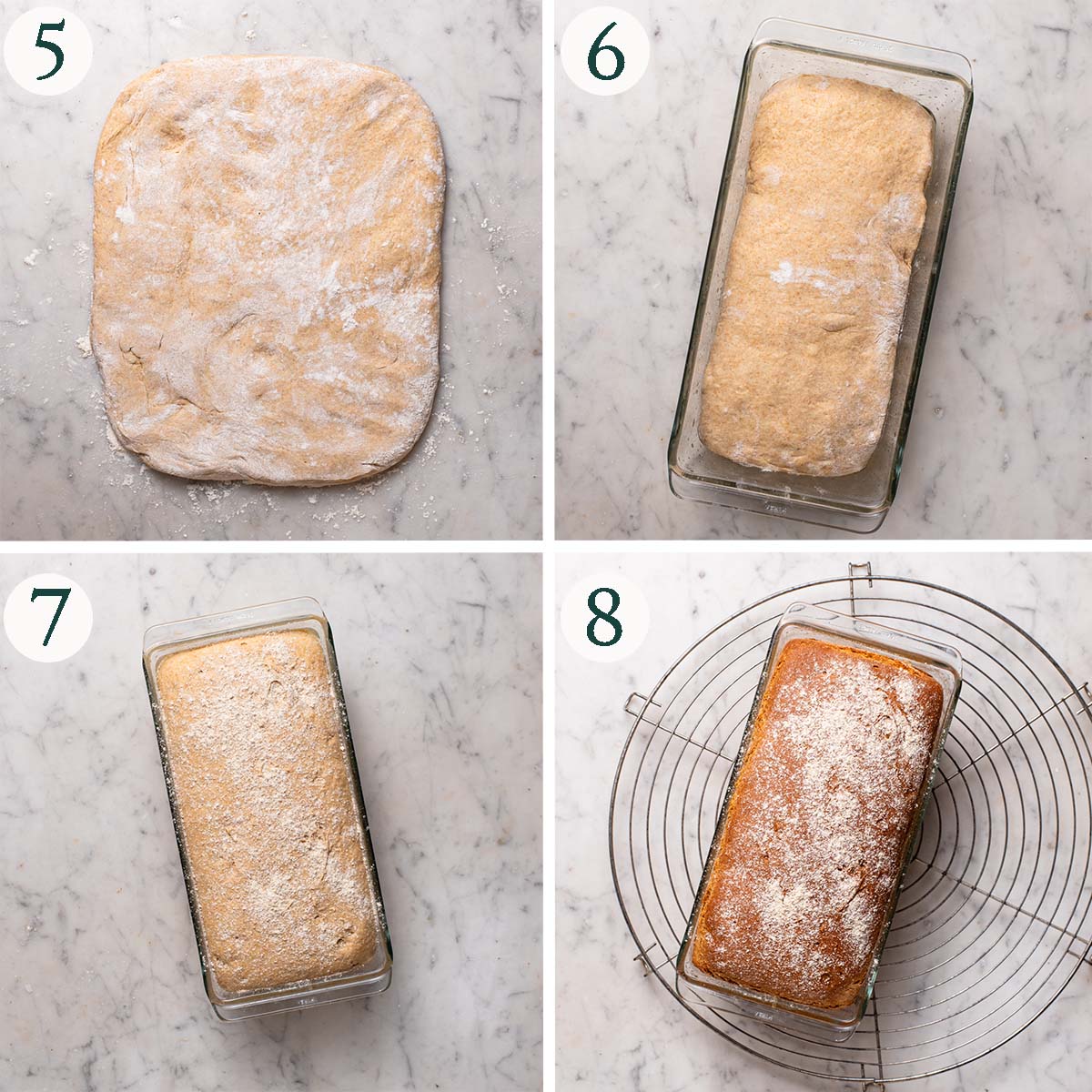
Step 5: turn the dough out onto a lightly floured surface and pat into a rough rectangle. The short edge should be about the same length as your bread tin (pictured is 26cm or 10 in.).
Step 6: roll into a tight spiral and place into the greased or lined loaf tin, tucking the ends under to tidy up the loaf. It is a soft dough and will lose its shape slightly when transferred.
Step 7: flour the top of the loaf and cover to rise again for about half an hour. In a standard bread tin it will just crown over the edge. Tea towels do tend to stick to the top of the loaf so if you’re good at knowing when the dough is fully proved, you can let it rise in the oven with a tray of hot water instead of covering (a steam rise). The timing will be different in that case, less reliable, but it is my personal preference – it’s harder for beginners, though, so I don’t outline it in the recipe card.
Step 8: bake the loaf until golden and the interior temperature is 90°C (190°F). Cool fully before slicing to avoid any potential gumminess or pilling.
Expert Tips for the Best Loaf
- Don’t add too much flour: this is probably a slightly stickier dough than you’re used to, but resist adding too much more flour. I really recommend using weight measurements for bread baking unless you can go by feel, but even then, note that the dough is a bit sticky even after kneading and that’s typical with whole grain ancient grain dough.
- Some tearing is normal: don’t worry about some slight tearing at the top of the loaf after it rises (pre-bake). Even if you’re an expert shaper, this dough has a tendency to break slightly either during rising or baking.
- Bubbles are also normal: you might see a bubble or two near the top of the loaf after baking. This is normal for this type of whole grain bread and is usually indicative of slight over-proving.
- Use a bread machine at your own risk: you can probably use a bread machine for this recipe, but I’ve never tried. My concern would be that the automatic settings would result in a too long kneading time for the lower-gluten flour.
Baking with Einkorn
Like all ancient grains, einkorn contains less gluten and some people find it easier to digest than standard wheat. It’s common in Europe and easy to find from many small-scale farmers. I know it’s grown in the Canadian prairies, too, with a few small farms growing it alongside other grain varieties.
The flavour of whole grain einkorn flour can’t be beat – especially if you’re used to conventional wheat – with a nutty, complex taste, almost as if it’s been toasted. It does act differently from other types of wheat and can’t really be subbed 1:1 so it’s best to use einkorn-specific recipes when you’re baking.
It’s one of my go-to grains and I always have the whole grains on hand for my home mill or get pre-ground flour if we’re travelling. Some mills and shops will sell white or ‘all-purpose’ einkorn flour but I’ve never used it.
More Ancient Grain Bread Recipes
- Emmer Bread – this is an overnight recipe, and very easy, also made with whole grain flour plus a little spelt flour for more structure.
- Khorasan Bread – made with all khorasan flour (kamut) it’s a high-hydration loaf with a wonderful buttery flavour.
- Honey Oat Bread – with only spelt flour and rolled oats, it’s a more complex version of a classic loaf.
- Sourdough Rye Bread – another very German bread, this is a traditional dense rye sourdough with about half spelt half rye.
If you make this Einkorn Bread or any other bread recipes on Occasionally Eggs, please take a moment to rate the recipe and leave a comment below. It’s such a help to others who want to try the recipe. For more OE, follow along on Instagram, Facebook, and Pinterest, purchase the Occasionally Eggs cookbook, or subscribe for new posts via email.
Einkorn Bread
Description
Ingredients
- 300 ml (1 ¼ cups) water room temperature
- 2 ¼ teaspoon dry yeast (1/2 cube fresh)
- 3 tablespoons olive oil
- 1 tablespoon honey
- 500 to 550 grams (~3 ⅔ cups) einkorn flour
- 1 teaspoon sea salt
Instructions
- Add the water to a large mixing bowl. Add the yeast, oil, and honey, and whisk to combine.300 ml (1 ¼ cups) water, 2 1/4 teaspoon dry yeast, 3 tablespoons olive oil, 1 tablespoon honey
- Add about a third of the flour to the bowl and mix to combine. Add the remaining flour and salt, and stir until a shaggy dough forms.500 to 550 grams (~3 ⅔ cups) einkorn flour, 1 teaspoon sea salt
- Cover the dough for ten minutes and let it rest before kneading. This allows the whole grains to absorb some of the water and makes the dough easier to work with.
- Turn the dough out onto a lightly floured surface and knead, adding a sprinkling of flour when needed (don't add too much). After about six minutes, the dough should be soft and smooth. Don't over work it. This can be done in a standing mixer, kneading for about four to five minutes on low speed.
- Place the kneaded dough back into the mixing bowl and cover with a tea towel and large plate. Set aside to rise until doubled, about an hour at room temperature.
- Punch the dough down and turn it out onto a lightly floured surface. Gently press it into a rough rectangle (the short edge should be the length of your bread tin). Make sure the dough isn't sticking to the work surface, then roll it into a tight spiral.
- Line a bread tin with parchment paper, or grease with a light-tasting oil or butter. Pictured is a 26cm (10 in.) long dish and is the perfect size for this recipe.
- Place the dough seam-side down into the prepared bread tin. Cover and set aside to rise again until puffy but not doubled, about half an hour.
- While the dough is rising, preheat the oven to 180°C (350°F).
- Once fully proved, bake the bread for 40-45 minutes, or until golden brown. If it's browning too much for your preference, cover loosely with foil or a piece of parchment paper. You can check the interior temperature with a thermometer (it should be 90°C or about 190°F when baked). For a softer loaf, brush the top with butter or coconut oil as soon as it comes out of the oven.
- Cool the loaf for ten minutes before removing from the tin and cooling fully on a wire rack. Keep in an airtight container or wrap well to store. Einkorn bread freezes well.
Video
Notes
Nutrition
Nutrition is provided as a courtesy and is an estimate. If this information is important to you, please have it verified independently.

I have tried making an Einkorn bread before but never had a satisfying result until today.
All the measurements were perfect. Thank you.
Hello. I want to make this recipe and know that weight measurements are best for fresh milled flour but the recipe measurement is in cups. Could someone please let me know what the weight measurement is for the flour? Thank you.
Hi Sherry, I’m a bit confused by this comment, as all of my recipes are grams-first and the cup measurement is in brackets behind the weights. I only include cups because I always get requests for them – I bake with grams. You need 550 grams of flour for this recipe.
I did the right amount of wet ingredients, and the dough wasn’t sticky, kind of dry actually. What did I do wrong?
Hi Justin, my first thought is that you might have measured with cups rather than weights (I should remove the cup measurements from this recipe) as they’re inaccurate. I would reduce the amount of flour and add it bit-by-bit while mixing with a spoon until the dough looks as pictured in step 3 (before kneading) if using cups. If you measured with grams, it could be down to an absorption issue as flour can absorb more or less liquid depending on a few factors. Either way I recommend mixing in the flour gradually in future.
Can I make this in a bread machine? I don’t mind doing it by hand but I just received a machine as a gift. Thank you!
Hi Madeleine, I haven’t tried this with a bread machine and my concern would be that it would be over-mixed. I think if you can set the kneading time manually then it might be okay!
Would any of the amounts or proportions need to be changed for freshly milled unsifted flour? Or is this specifically for store bought whole grain?
Hi Brida, I’ve made it with both freshly milled (in my home mill) and store-bought whole grain einkorn flour. Depending on the coarseness of your grind – if home milling – you may need to adjust the amount of liquid slightly, but if you’re an experienced bread baker, that shouldn’t be an issue. Look for the right consistency when kneading and adjust the amount slightly if needed.
My first time using Jovial organic whole wheat flour for baking bread. My bread turned out fantastic following this recipe. The only adjustment I will make next time is adding a bit more salt.
What particular kind of yeast was used in this recipe?
Hi Sarah, pictured is fresh yeast. I use fresh, traditional dry, or instant interchangeably here because the yeast is mixed with the liquid ingredients first. Instant yeast might result in a slightly faster rise.
Can I use instant yeast for this recipe?
Hi Samantha, should be fine. You can add it with the dry ingredients but keep an eye out as it may rise faster.
Can I make this recipe with all purpose Einkorn flour instead of whole wheat Einkorn flour?
I don’t see why not – the dough will be a little more wet, but it should be fine as all-purpose will have a bit more gluten as well.
Could this dough be made in an stand mixer?
I don’t see why not! Just be sure not to over-mix it, probably only for about 3-4 minutes (but you’ll have to check it, because I don’t have a stand mixer to test with).
Great! Thank you for your feedback!
First time making bread, and it came out perfectly. Thank you for sharing your recipe.
Worked like a charm! Other than using maple syrup instead of honey, I followed the recipe exactly. Spraying my stoneware loaf pan with oil worked well (instead of parchment paper).
It’s no sourdough, but it was a great quicker bread. It rose well (though it’s still dense since it’s whole grain) and tasted good.
I’ll definitely use this recipe again when I don’t stay on top of refreshing my starter (or when I need a fresh loaf quickly).
One more thing: this recipe worked MUCH better for me than Jovial’s bread machine recipe for 100% whole grain einkorn.
Hello, can I use sourdough starter instead of yeast? thanks
I haven’t tried this with sourdough yet, but I think it would need different amounts. It’s on my list though!