


Saffron Bread, a Traditional Christmas Treat

My mom always has a bit of saffron in the house and we used to bake a saffron wreath, braided bread, or buns around Christmas every year. It’s very common in Northern Europe, but you might be most familiar with lussekatter, the pretty saffron buns made in Sweden for St. Lucia’s Day, a solstice celebration. They’re made throughout the holiday period but more traditionally on December 13th.
Our saffron breads during my childhood were heavy on butter and dairy milk, and I don’t remember them ever including chocolate or dates, but it’s the same idea. It’s just a vegan saffron loaf instead. The dark chocolate in combination with the rich saffron dough is spectacular, as is the sweetness and caramel notes of the dates and dark sugar.
I know saffron is outrageously expensive, and it’s certainly not something you use every day. It’s something very special for the holidays, though, and a very worthwhile splurge to get a gram or two to make a festive saffron bread shaped as a wreath.

I first published this recipe in 2018. It’s been updated with new step-by-step photographs, more helpful information, and some slight improvements to the recipe.
Ingredients You’ll Need and Why
Like all of my bread recipes, this one is made with an ancient grain rather than modern wheat flour – in this case light spelt for a soft bread. You can use regular wheat flour (see below). These are my notes from testing and the full recipe card can be found below.
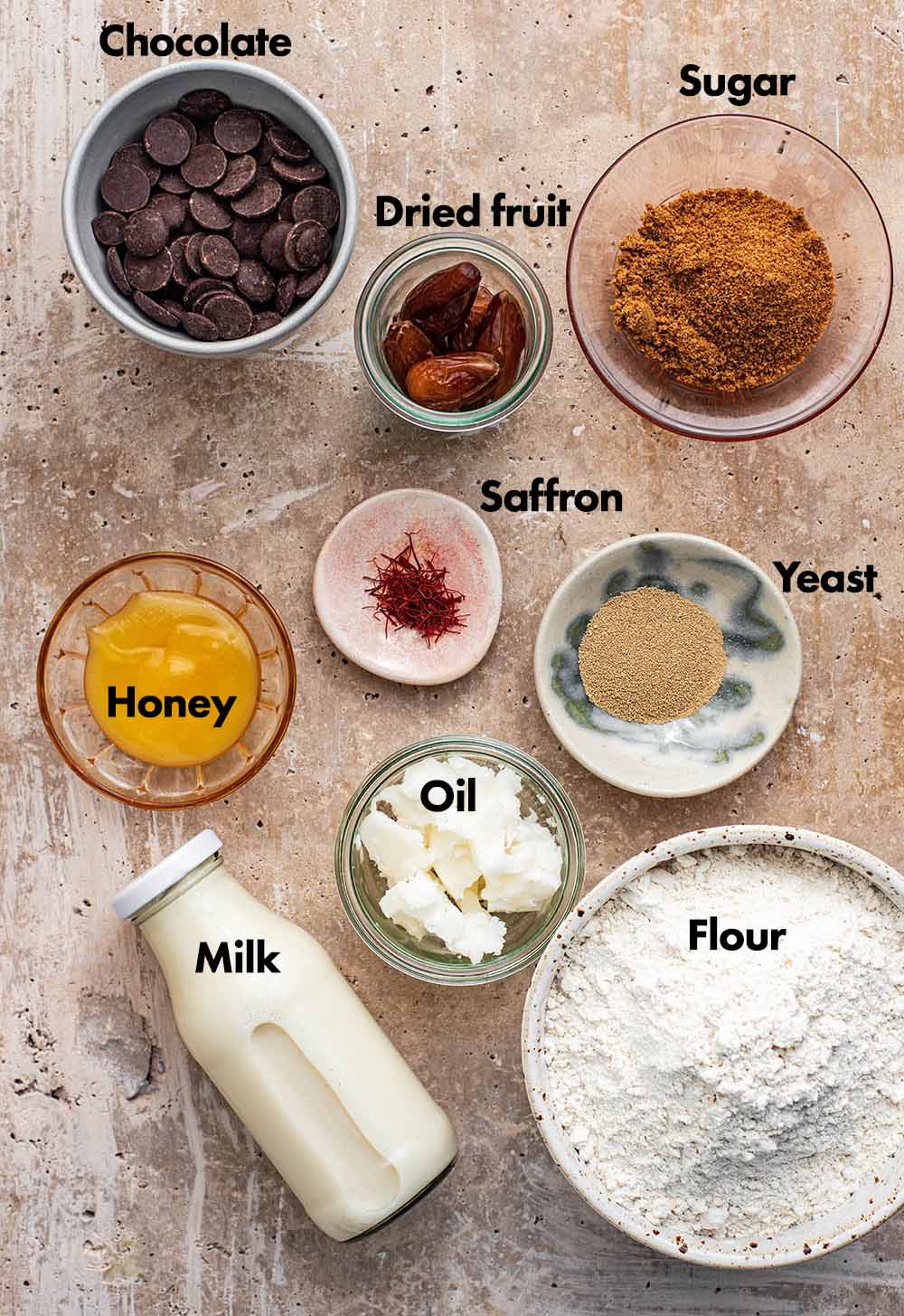
- Saffron: try to look for saffron threads that are sold in opaque containers or bags, not the little clear plastic display packs. Exposure to light ruins the delicate flavour of saffron and it’s too expensive to buy bad quality.
- Spelt flour: use light (also called sifted or white) spelt flour for the best texture. Plain white flour can be used in place of spelt, but note that the kneading time will have to increase if using white flour.
- Sugar: use a dark sugar for the best flavour, like muscovado, brown, or coconut sugar. Plain sugar can be used if you prefer. I don’t recommend trying to use a liquid sweetener in place of the sugar.
- Yeast: this recipe is developed with active dry yeast and that’s why it’s bloomed with the milk first. You can use instant yeast with no change to amounts, and it can be added with the dry ingredients. If you live in North America you can use traditional, quick, and instant yeast interchangeably here (I can only get the equivalent to traditional). Fresh yeast can also be used.
- Milk: I always use non-dairy milk, either oat or soya. Dairy can be used in the same amount. Dairy and soya will make the dough slightly more elastic.
- Coconut oil: butter can be substituted for coconut oil for both the dough and the filling if preferred. A non-dairy butter alternative works too.
- Add-ins: the chocolate and dates can be omitted if you prefer, or substitute something like raisins. Try cinnamon or cardamom in the filling if you’re not adding chocolate.
How to Make Saffron Bread
It might seem complicated, but this type of enriched sweet bread is actually easy to work with because of the added oil. The dough should be soft, but not at all sticky, so it won’t stick to your hands at all when shaping.
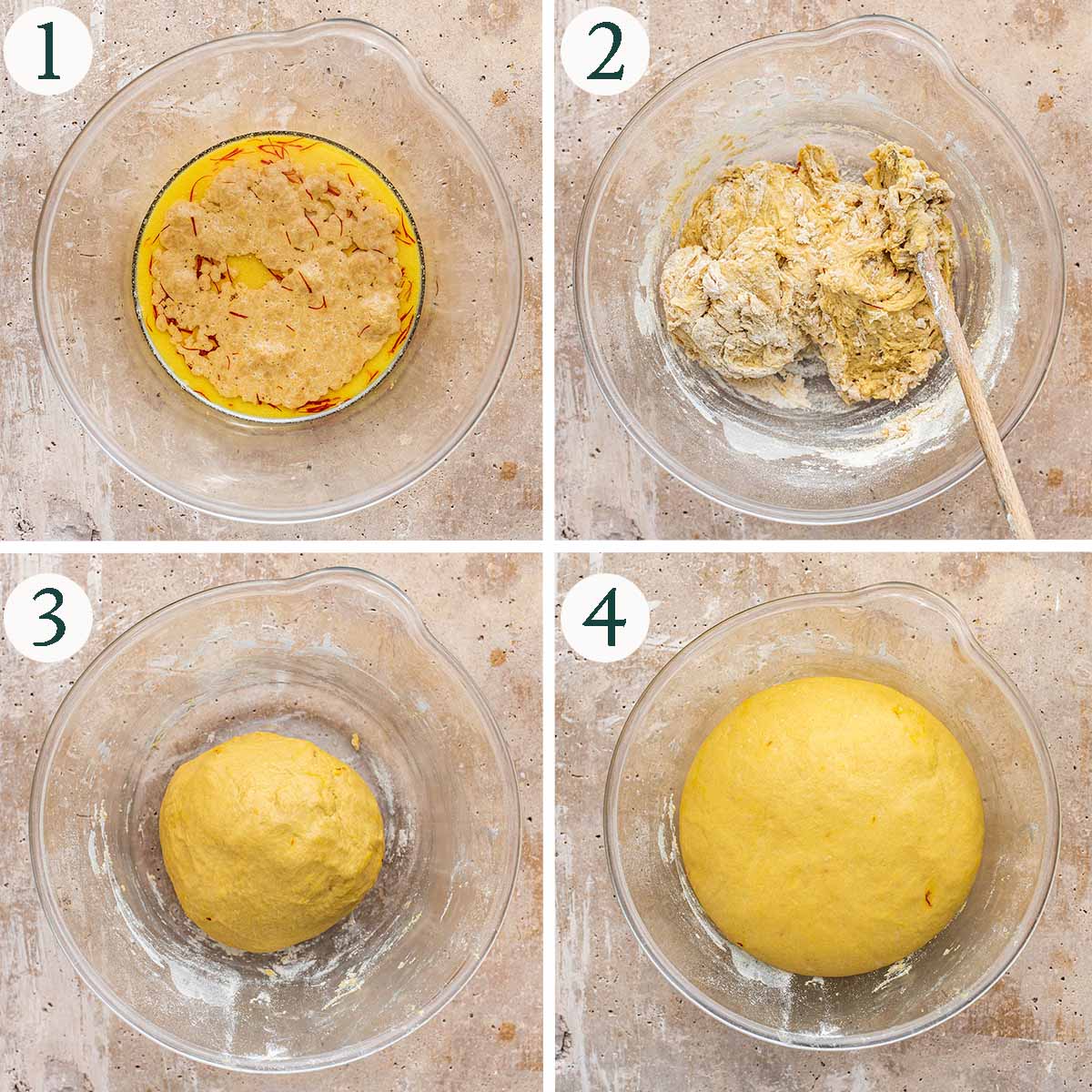
Step 1: heat the milk and saffron, then whisk in the oil and honey. Make sure it’s cooled enough before adding the yeast. It should feel just warm to the touch, not hot! This is called ‘blooming’ the yeast and will activate it.
Step 2: add the flour and salt, mixing to form a shaggy dough. It will seem too soft at this point because it’s still warm and hasn’t been kneaded yet.
Step 3: knead the dough by hand or with a machine until soft and smooth. When it’s ready, the dough won’t be sticky and should be easy to handle. Place the dough back into the bowl to rise.
Step 4: cover the bowl – I use a tea towel and a large plate – and set in a warm, draft-free place like the oven with the light on. Don’t prove dough too near a heat source like a radiator. If it rises too quickly, it impacts the yeast.

Step 5: roll the dough out into a large rectangle and add the filling ingredients. Pictured here are couverture chocolate drops but they are a little bit too big, really, so I recommend chopped chocolate instead.
Step 6: roll the dough into a tight log, then halve lengthwise. It will get a little bit messy at this point from the add-ins, but they can be pushed back into the dough later if needed.
Step 7: twist the pieces around each other, then join to form a wreath. The dough can be used to make different shapes as preferred.
Step 8: bake the bread for about 30 minutes. The bread will be a darker golden colour when it’s ready, but it can be hard to tell because of the saffron. It should feel firm to the touch when it’s baked.
Expert Tips for the Best Saffron Bread
- Use a mixer: I’ve provided instructions to knead by hand, but you can also use a stand mixer. Just follow the same directions but mix with your kneading attachment, adding the flour a bit at a time, until a soft dough forms.
- Shape differently: if you want to make this bread but a wreath scares you, then just cut the roll into rounds and bake it like cinnamon buns. It’ll taste the same, but won’t be quite as festive.
- Check your yeast: I highly recommend either buying fresh yeast for this recipe or testing your yeast beforehand! You don’t want to waste that precious saffron on dead yeast.
- Add the filling back in: the dough will want to fall open a bit when you cut it, especially if your dates are cut a little big. Don’t worry if some of the filling falls out, you can just add it back into the dough before it rises the second time.
Braiding the Dough
To create the saffron wreath, you roll the dough lengthwise like cinnamon rolls, then cut down the middle lengthwise to create two pieces of dough with layers. Leave an “anchor” at the top, about 5cm (2 inches) where you don’t cut it. Then you twist the two strands around one another from top to bottom, keeping the cut side facing up, and then form it into the wreath.
A trick to make sure the wreath has a nice looking join is to take the two strands of dough, separate them from the coil, and wrap them around the other end of the wreath where you want to make the join. I usually cut the anchor after my two-strand braid is completed and use that to create the join. So instead of trying to squash the ends together, you’re wrapping it instead and sealing underneath. I hope that makes sense.
More Sweet Bread Recipes
Swedish Cardamom Buns
Vegan Pumpkin Cinnamon Rolls
Rhubarb Streusel Cake
Vegan Lemon Challah
If you make this Saffron Bread or any other ancient grain bread recipes on Occasionally Eggs, please take a moment to rate the recipe and leave a comment below. It’s such a help to others who want to try the recipe. For more OE, follow along on Instagram, Facebook, and Pinterest, purchase the Occasionally Eggs cookbook, or subscribe for new posts via email.

Saffron Bread
Description
Ingredients
- 250 ml (1 cup) non-dairy milk or regular dairy milk
- 1 pinch saffron threads ~½ gram
- 3 tablespoons coconut oil
- 2 tablespoons honey or sugar
- 2 ¼ teaspoons dry yeast or ½ cube fresh
- 450 grams (2 ½ to 3 cups) light spelt flour
- ½ teaspoon sea salt
Filling
- 2 tablespoons coconut oil softened
- 50 grams (¼ cup) sugar a dark sugar is best
- 50 grams (¼ cup) dark chocolate chopped
- 50 grams (¼ cup) dates finely chopped
Instructions
- Add the milk to a small saucepan with the saffron threads and heat over low-medium until just simmering. Whisk in the coconut oil and honey, then pour into a large heatproof bowl.250 ml (1 cup) non-dairy milk, 1 pinch saffron threads, 3 tablespoons coconut oil, 2 tablespoons honey
- Let the milk mixture cool until just warm to the touch, then whisk in the yeast. Leave it for 15 minutes, or until foaming.2 ¼ teaspoons dry yeast, 450 grams (2 ½ to 3 cups) light spelt flour, ½ teaspoon sea salt
- If using cups, stir in 1 cup of flour along with the salt. Add the remaining flour in ½ cup increments, stirring between each addition, until it becomes too difficult to mix with a wooden spoon. If measuring with grams (recommended) you can add all the flour at once.
- Turn the dough out onto a lightly floured surface and knead until a soft, smooth dough forms, around eight minutes by hand or five to six minutes with a machine. Resist adding too much more flour if kneading by hand.
- Place the kneaded dough back into the bowl. Place a large plate over the bowl and set it into a warm place to rise until doubled in size, about an hour.
- Set aside a large baking sheet. Turn the dough out onto a lightly floured surface and roll into a large rectangle, about 1.5 cm (¾ inch) thickness. Spread with the coconut oil, then top with the sugar, chocolate, and dates in an even layer.2 tablespoons coconut oil, 50 grams (¼ cup) sugar, 50 grams (¼ cup) dark chocolate, 50 grams (¼ cup) dates
- Roll the dough up lengthwise into a log, the cut lengthwise down the centre into two long strips. Leave the top 5 cm (2 inches) of dough uncut to create an anchor.
- With the cut side facing up, twist the two pieces around one another, lifting one and placing it over the other from top to bottom. Give yourself plenty of space for this.
- Form the wreath. Bring the ends around to each other, then cut your anchor and wrap the two pieces around the other end of the coil and tuck underneath, pressing lightly to stick. I recommend doing this on a sheet of parchment paper so that it can be easily transferred to the baking sheet.
- Gently lift your completed wreath onto the baking sheet and cover with a clean tea towel. Adjust to make sure you have the desired shape (now, before it proofs a second time).
- Place in a warm spot to rise again for 30 minutes, covered with a tea towel.
- While the dough is proofing, preheat the oven to 180°C (350°F). Once it's finished rising, bake the wreath for about 30 minutes, or until lightly golden.
- Cool on the baking sheet for another 20 minutes before cooling fully on a rack. Saffron bread is eaten fresh, but leftovers will keep in a well sealed container on the counter for up to three days.
Notes
Nutrition
Nutrition is provided as a courtesy and is an estimate. If this information is important to you, please have it verified independently.
About Alexandra Daum
Alexandra Daum is a professional recipe developer, food photographer, and cookbook author. She started sharing carefully tested vegetarian recipes in 2014 and has since published hundreds of recipes with seasonal ingredients and whole grains as the focus. Her work has been featured on CTV, in House & Home and Chatelaine, on popular websites like Buzzfeed and Best Health, and in countless other publications.