

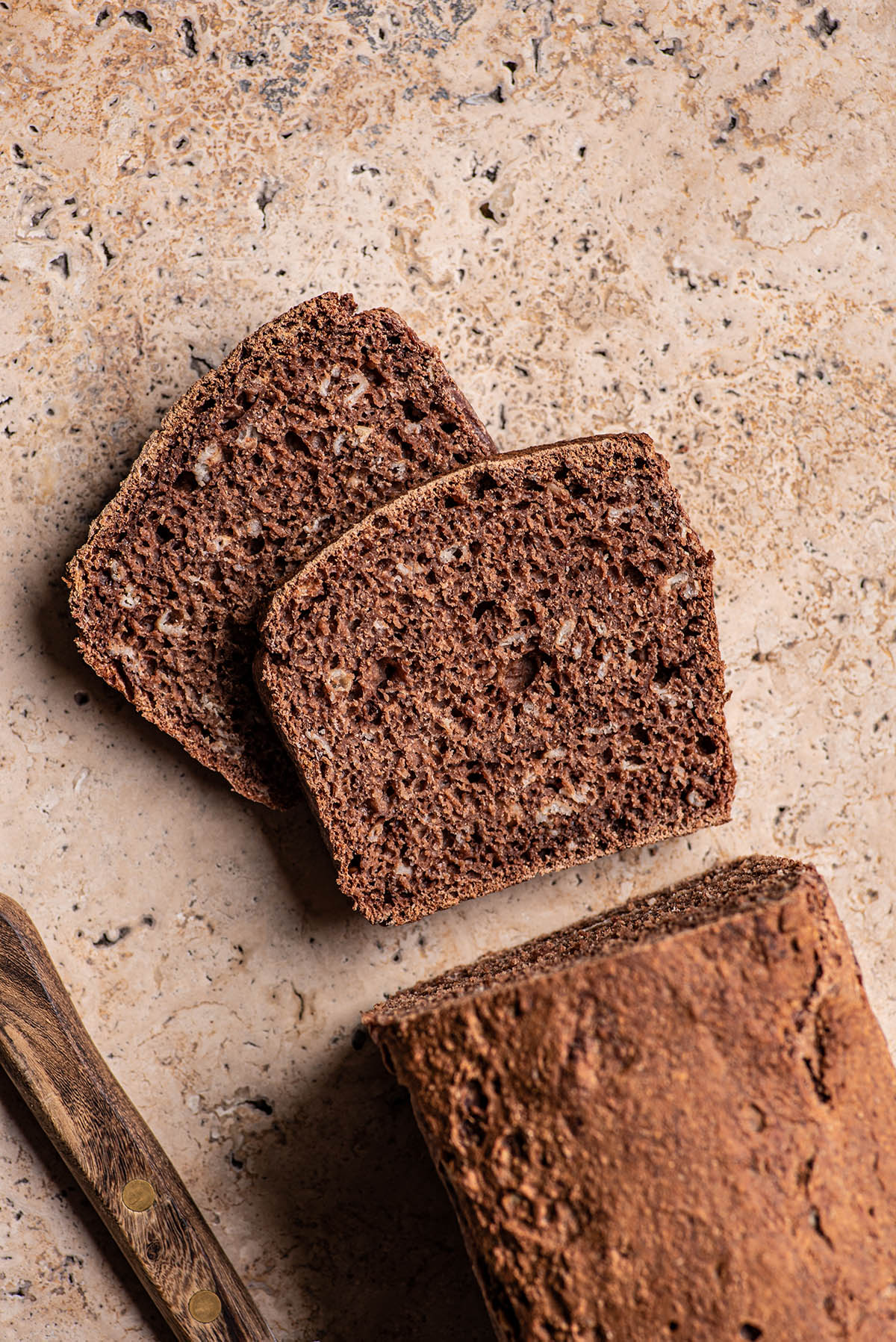
I love overnight bread. It’s much easier to make than normal homemade bread, without any kneading necessary – you just mix everything together in a bowl, let it sit overnight, and then bake it in the morning. This is a typical north German rye bread, dark and slightly sour.
The usual problem is that it’s usually baked in a dutch oven or lidded ceramic dish and involves some dough folding and sitting in a tea towel in the morning after it’s risen overnight, which I find detracts a bit from the simplicity of the method.
The dough rises a second time in the pan you bake it in, so you don’t need to worry about proper folding technique or anything like that. All you have to do is mix it the night before, dump it in a loaf pan, and bake it. No kneading, no folding, no special equipment.
Despite the lack of work that goes into this bread, the crust is surprisingly crispy, and the inside of the loaf is soft and tender. It also lasts longer than other homemade breads, and it keeps for at least a week sitting on the counter, wrapped well.
If you like the idea of rye bread but don’t want to go all the way to a dark rye, try this overnight spelt rye bread instead, or sourdough rye bread if you prefer a natural yeast version.
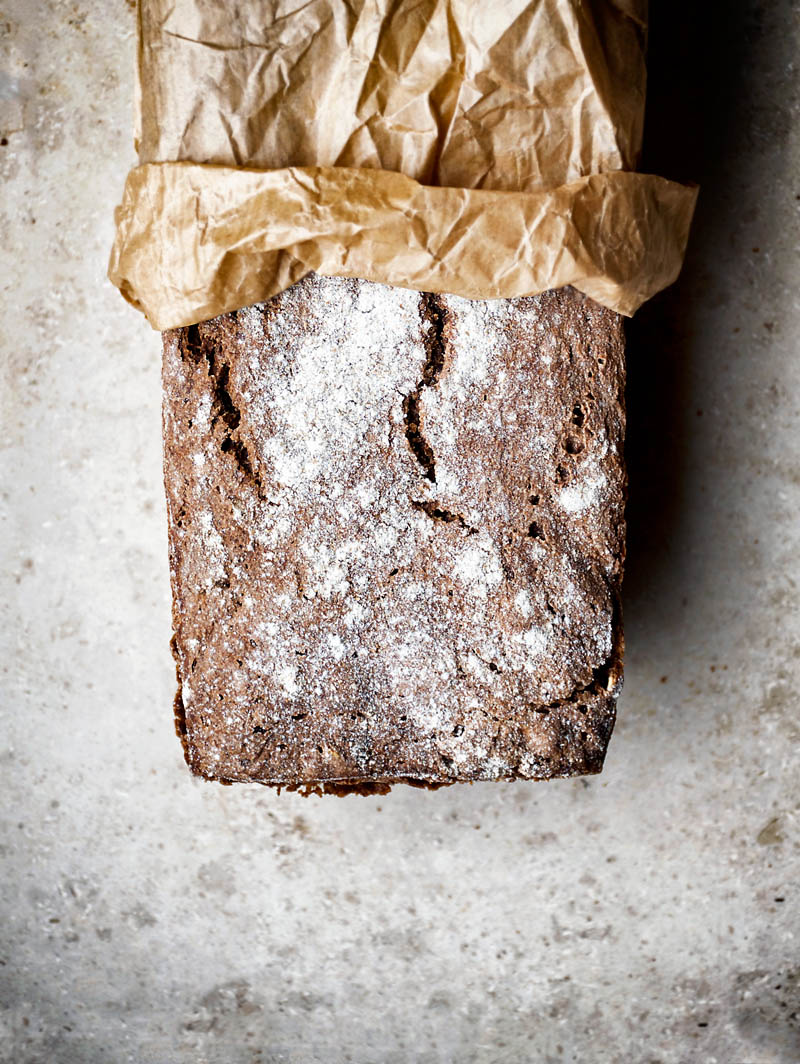
Please note that the darker photos are made with regular cocoa powder and yeast, and the lighter bread is made with sourdough starter and natural cacao. The step-by-step photos are sourdough, so if you want to see the steps for the yeast method, please watch the recipe video.
One reader, Marina, commented: “We have made it 2 times – both times outstanding texture. First time – as written, with rye and regular wheat flour, it ended up being overpowered by cocoa and mild bitterness – not bad, but too mild in flavor. Second time – with spelt and rye and half of cocoa and some cumin and seeds on top. Really outstanding flavor. Thank you for coming up with this recipe – so easy to make and beautiful results even for non-baking people.”
Another reader, Janie, said: “Thank you for this recipe – it makes a delicious loaf that lasts for days. I have been looking for ages for an easy ancient grain recipe and this one hasn’t failed me yet. It’s great to experiment with additions – I’ve enjoyed fennel seeds, caraways seeds and will try a sweet loaf with cranberries for Christmas.”
Ingredients
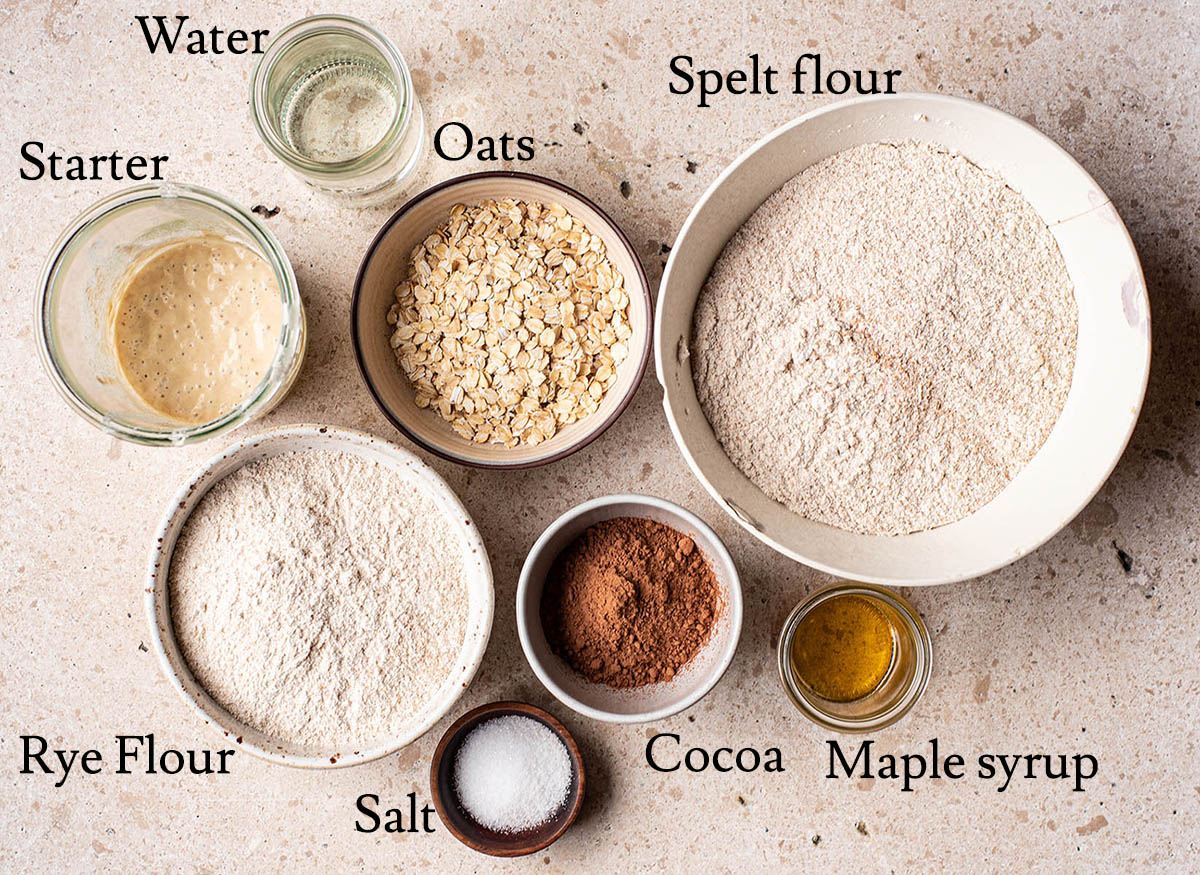
- Whole grain spelt flour: if you don’t have spelt flour, all-purpose makes an excellent substitution. Whole wheat flour can be used as well, but you’ll have to reduce the flour slightly or increase the water a bit to make up for the greater absorption.
- Rye flour: sometimes called dark rye flour, this should be whole grain rye, though light (sifted) rye flour can also be used.
- Rolled oats: the oats can be left out if you prefer – I often omit them – though it is better to increase the amount of flour used by a couple spoonfuls in this case as the oats do absorb a fair amount of water.
- Cocoa powder: make sure you’re using 100% cocoa powder, not hot cocoa drink powder. There shouldn’t be anything like sugar or milk powder in it.
- Yeast (dry or fresh) or active sourdough starter: traditional yeast (not quick rise) is ideal, but it doesn’t make that much of a difference. Active starter can be any starter made with a gluten-containing flour – rye, plain flour, spelt, and so on. There’s a recipe in my cookbook for rye sourdough starter.
- Add-ins: dried fruit, seeds, and nuts can be added to the dough as well. I recommend mixing it in after the bulk rise (overnight) before placing the dough into the tin to rise a second time. Raisins, dried cranberries, and sunflower seeds are my favourite additions. You can also top the loaf with seeds, which makes for a very pretty gift.
Step by Step
See the recipe card notes for instructions on how to make this into a sourdough loaf. The step-by-step photos show the sourdough method because the video shows it made with yeast, so in the interest of maximum information, I wanted to include both.
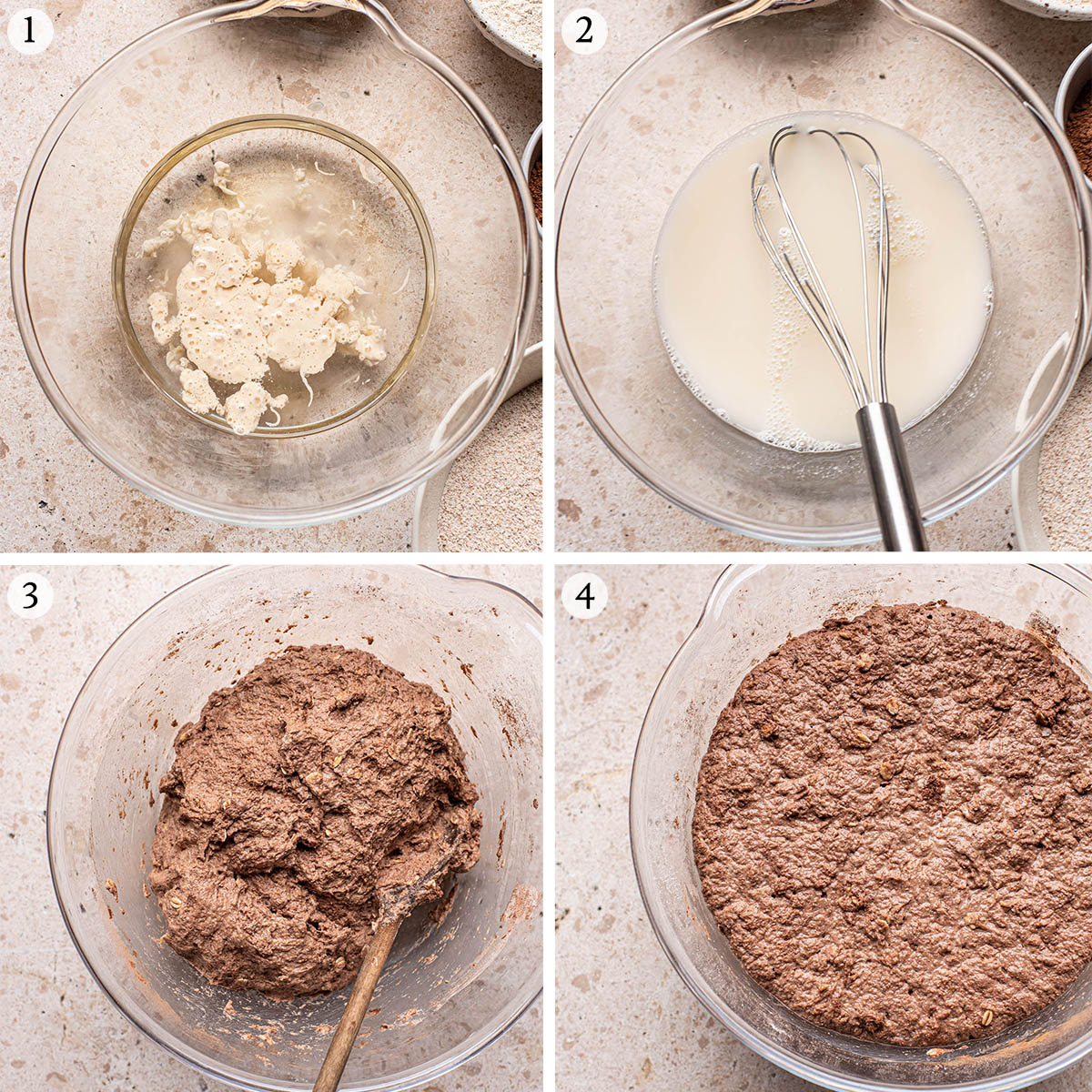
1. Add wet ingredients: add the water, maple syrup, and active starter to a large bowl. The starter should float. If using fresh yeast, add it now.
2. Mix: whisk to combine well.
3. Add dry ingredients: stir in the flours, oats, cocoa, and salt. Add the dry yeast now if using that method and stir into a shaggy dough.
4. Rise: cover with a plate, board, or tea towel, and set it into a room temperature, draft free place for about 12 hours.
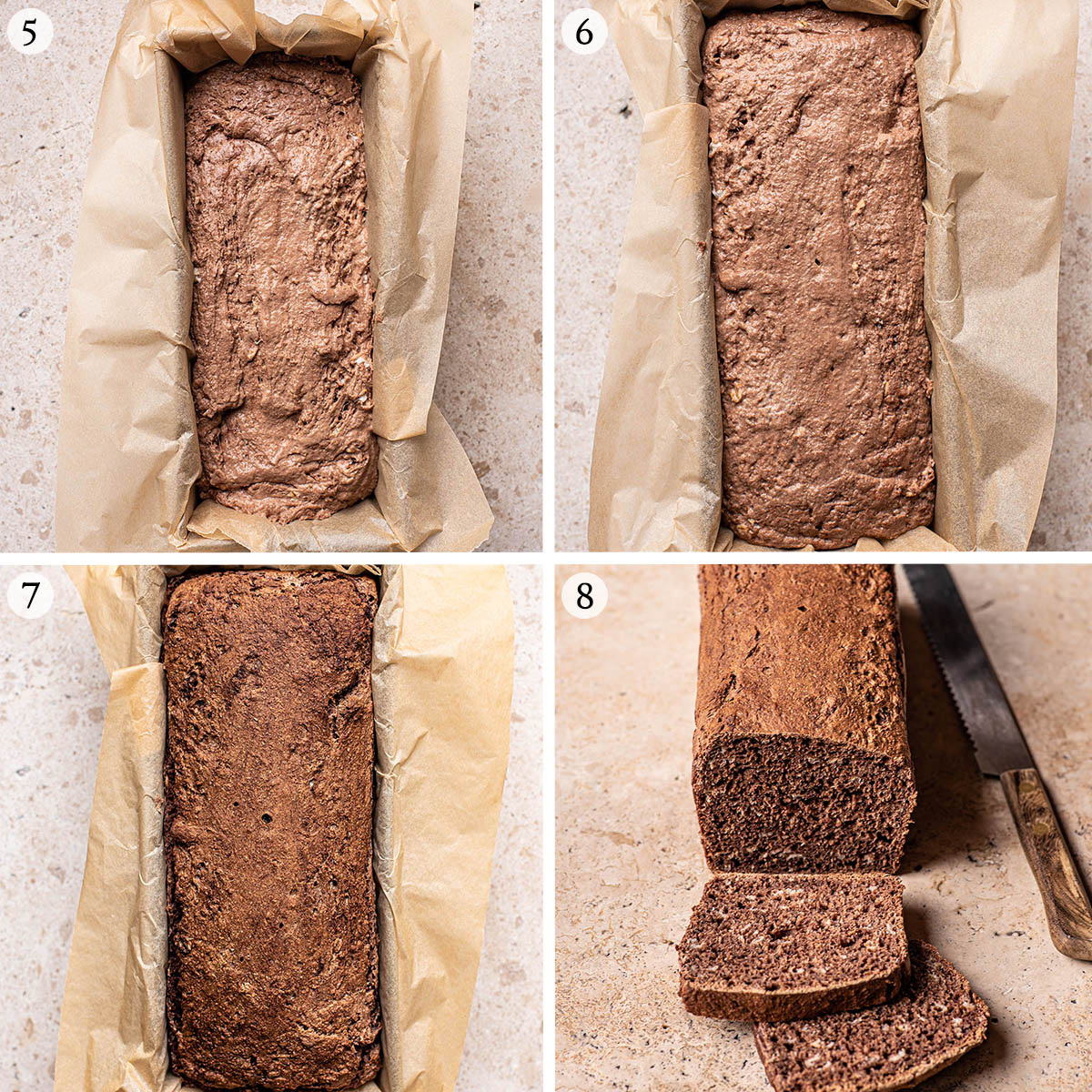
5. Transfer: once the dough as risen, place it into a well greased or parchment lined bread tin. It will lose volume here.
6. Rise: cover the loaf with a tea towel and set it into a draft-free place to rise again for a couple of hours. The dough should be expanded but not quite doubled after this time.
7. Bake: bake the loaf for about 45 minutes, or until the bread sounds hollow when it’s tapped.
8. Cool and serve: cool the bread completely – at least six hours, preferably overnight – before slicing and serving.
Recipe Notes
Like most darker whole grain breads and sourdough loaves, this one needs to rest for a significant amount of time before slicing. The recipe states to let it cool completely – that may mean several hours or even overnight. If you want really nice clean slices I recommend letting the baked loaf sit overnight in a tea towel before slicing the following day.
If you want to make this into a boule, you’ll have to introduce some stretches and folds. I recommend 4 rounds, starting directly after mixing. After the dough has risen overnight, shape it as you usually would and place it into a well floured banneton. Bake in a dutch oven 30 minutes covered and another 15-20 minutes uncovered, at 230°C (450°F).
The dark colour and traditional dark rye flavour here come from the whole grain flours and cocoa powder. It’s not quite a German black bread, which I grew up with, but this style of rye bread is also very common in northern Germany (where I lived) and Scandinavia (though it is hard to find in Gothenburg). If you feel that the cocoa will make it too bitter – though that is kind of the point – you can leave it out, no problem.
How to Store
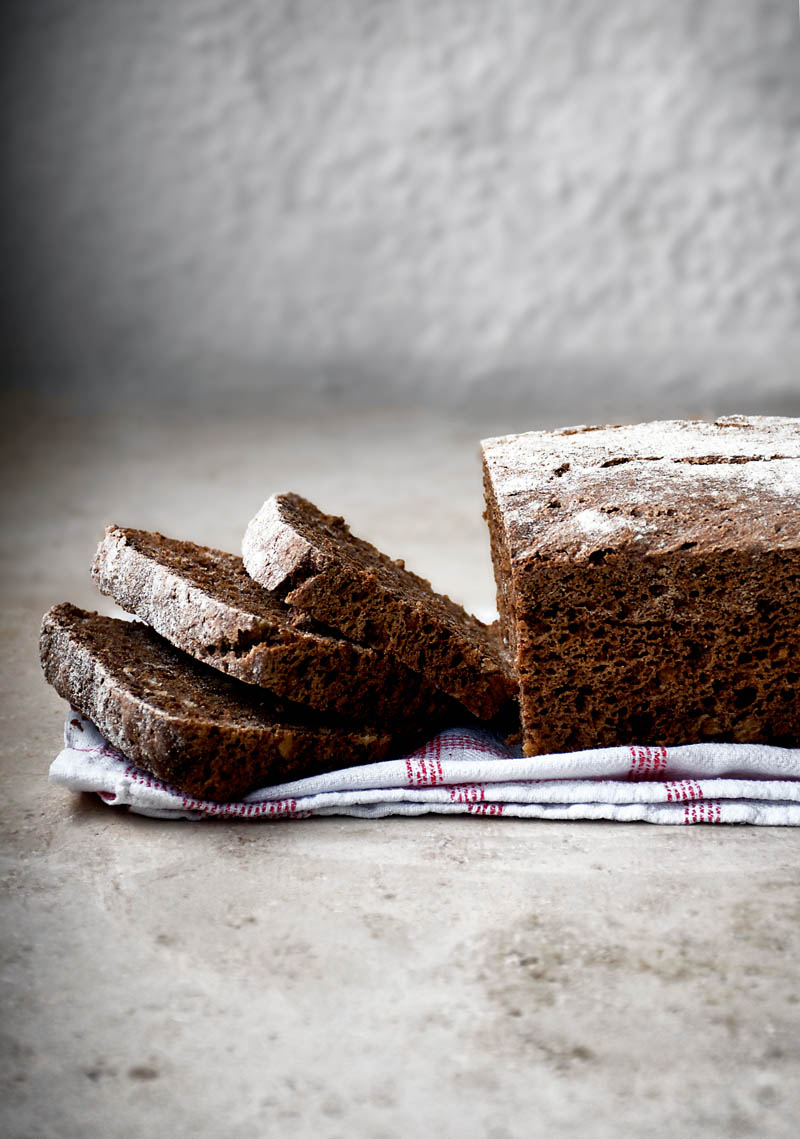
Storage: the bread keeps well, wrapped in a tea towel, for about a week. The crust will harden slightly but the middle will still be fresh. You can also use a bread bin or sealed container, but I don’t recommend storing this in a plastic bag.
Freezing: this loaf freezes spectacularly, and I highly recommend having some in the freezer at all times. Freeze the whole loaf or pre-slice and take out individual pieces to toast, but either way it’s well worth freezing some in an airtight container.
Expert Tips
- Choose a good draft-free spot: I usually keep my dough in the oven with the door closed, no light needed, for the initial prove.
- Keep an eye on the dough the first time: you may need slightly less time if your starter is very active. The dough is finished the bulk proof when it’s approximately doubled in size.
- Don’t worry about overdoing it: the colour is harder to gauge because the loaf is so dark, but the outer crust should be quite hard and crisp when finished (it’s difficult to over-bake this bread).
- Serve with strong toppings: this is excellent with mirabelle jam, for example, something quite tart. We often have it with peanut butter but a sharp cheese is certainly more traditional.
- Refrigerate after shaping: if doing the sourdough method, it’s no problem to refrigerate the loaf for a few hours before baking. I recommend letting it rise at room temperature for an hour or so before refrigerating for the best results.
More Ancient Grain Bread Recipes
No Knead Honey and Oat Sourdough
Spelt Naan
Saffron Wreath Bread
Simple Spelt Bread
Einkorn Bread
If you make this Dark Rye Bread or any other bread recipes on Occasionally Eggs, please take a moment to rate the recipe and leave a comment below. It’s such a help to others who want to try the recipe. For more OE, follow along on Instagram, Facebook, and Pinterest, purchase the Occasionally Eggs cookbook, or subscribe for new posts via email.
Easy Overnight Dark Rye Bread
Description
Ingredients
- 500 ml (2 cups) room temperature water
- 1 teaspoon maple syrup or honey
- 450 grams (~3 cups) whole spelt flour
- 150 grams (~1 cup) rye flour
- 60 grams (½ cup) rolled oats
- 25 grams (¼ cup) cocoa powder
- 1 ½ teaspoons sea salt
- ¼ teaspoon dry yeast** or 100g active starter see notes
Instructions
- In a large mixing bowl, whisk together the water, maple syrup, and active starter or fresh yeast if using that option.
- Add the spelt, rye, oats, cocoa, and salt to the bowl. Add the dry yeast to the dry ingredients as well if that’s what you’re using. Stir with a wooden spoon to combine, mixing until no visible streaks remain.
- Cover the bowl with a lid, cutting board, or tea towel and let it sit for 12-15 hours at room temperature. It will at least double in size during this time.
- In the morning, grease* a bread pan (see notes) or line it with paper. Scrape the dough into the pan, and then press it down evenly (wet hands work well).
- Cover the dough with a clean dish towel. Let it rest again for 1-2 hours at room temperature.
- Heat the oven to 200°C (400°F). Once the oven is hot, place the bread on a middle rack and bake for 40-45 minutes. The crust will be hard and sound hollow when tapped once the bread is done baking.
- Remove it from the oven and place the pan on a metal rack to cool for 20-30 minutes before removing it from the pan to cool completely. The loaf will keep well for a week at room temperature, best stored in a cloth bag.
Video
Notes
Nutrition
Nutrition is provided as a courtesy and is an estimate. If this information is important to you, please have it verified independently.
This post was originally shared in October 2016. It has been updated most recently as of January 2023 with no changes to the recipe.

Can whole wheat flour be used instead of spelt? Thanks!
Sure can!
Wow. What a fabulous recipe. I followed the sourdough version, with my rye starter and the flavour and texture is incredible. I love that it is moist and not too heavy with a rich rye flavour. I’m now looking forward to making the other loaves on your site…which I’m finding is a real treasure trove. Thanks so much for the recipe. It will be a staple. 🙂 Also, just wondering is your loaf pan 30 inch by 10 inch?
I’m so happy to hear that you like the recipe, Lisa! The pan I use is 30cm or 12 inches, in length. A standard loaf pan will work well : )
Hi there,
Have you ever tried the overnight rise inside of a dutch oven? If so, can you please let me know if that worked for you. I would like to achieve a round boule loaf rather than one in a rectangular loaf pan.
Thanks, Carrie
Hi Carrie,
I haven’t tried that – it’s quite a sticky, soft dough, and needs to be constrained as it rises or it becomes a pancake. If you want a round loaf, it wouldn’t be a boule so much as simply round. What I’d recommend trying is doing a few stretches and folds after mixing and then doing a second shaping after the overnight rise to try to get a round loaf. Then let it rise in a bread basket or bowl (with parchment, or it will stick) and then baking in a hot dutch oven. I have done that and it works all right, but this recipe doesn’t lend itself as well as this one, for example, to a nice boule shape. As the overnight rise is done in a bowl before switching over to the baking form in any case, I don’t think you’ll get the results you want by having it do the bulk ferment in the dutch oven and then baking it in there without any shaping or preheating of the vessel.
That was a bit long winded but I hope it helps, good luck!
Carrie,
I now let my dough rise for an hour in a lightly floured smaller boule basket, then tip over on parchment and drop in hot dutch oven to bake. Works very well.
Hank
Just finished baking the bread. I used regular whole wheat flour and a half cup of my ten year old starter. I let the dough rest for about 20 hours; then kneaded slightly (less than a minute). I formed a loaf, placed it on flour dusted parchment paper and placed it in a 12 inch fry pan and cover it with plastic for two hours. Then I lifted it up and baked it like the famous “no knead” bread”…in a dutch oven. It was fantastic!! Thank you.
Hi Alexandra! a question about overnight rising – you leave your’s on the counter but at what temperature? I’m in southern Spain and it’s 26C in our kitchen at night! Less rising time perhaps? or should I try it in the fridge as I do for a ciabatta recipe I regularly use which requires an 8 hour overnight rise. Thanks so much for the recipe – can’t wait to try it despite the heat!
When it’s that hot, I do a shorter rising time or refrigerate. Essentially, you want it to double in size, so however you get to that point! I think an overnight rise in the fridge followed by the second rise on the counter will result in a nice loaf in those temperatures. I hope it works out and that you love the bread!
Thanks Alexandra! My dough had about 8 hours overnight and had risen so much it stuck to the plate cover! Have just got the baked loaf out of the oven… if it tastes as good as it looks, then this recipe is definitely for keeps. Thanks so much.
So happy to hear that, thanks Sophie!
Hi I have made this bread with wholemeal flour instead of spelt but found I had to add about half a cup more water as I couldn’t mix it all together without it. It turned out a nice bread but quite soft. Do you knead the dough when you mix it?
Hi Chloe, I think the bread turned out softer because of the added water. It’s a stiff dough and needs a strong arm when mixing! No kneading is required for this recipe.
Alexandra,
Thanks for posting this recipe. I am in the pursuit of recreating a bread I buy when in Michigan.
The bread is a spelt bread. Similar recipe except calls for yukon potato and no cocoa.
Any ideas on how to tweak the recipe in that way?
Thanks
Hmm, I’m not sure – but this is something I’ll work on this week and let you know (maybe a new recipe).
Do you mean the Dinkelbrot made by Zingerman’s bakery in Ann Arbor? The recipe is in their book.
Thank you so much for this beautiful recipe, I made it the other day and it was amazing! I cook in a romertopf which helps keep the outer crust super crusty. Your site is as beautiful as it is full of delicious recipes and I look forward to sharing more of these with friends and family!
Hi Alexandra,
Can white whole wheat flour be substituted for spelt flour?
I think that would work! I haven’t tried it, but it should be fine as they have about the same level of gluten.
I’d love to give this try! Have you tried including dried fruit and seeds? I’m keen to find a low-fuss fruit loaf that keeps well.
Thanks for your great recipes and blog posts!
Hi Jane! Yes, I often add sunflower seeds and sometimes raisins or chopped dates. It works well : )
This was the first time for me to make bread! It is delicious! I was very hesitant when I had initially mixed the ingredients together, looking so ‘glunky’ and all. After 15hours it had doubled in size, looked better – but then once transferred to the pan for another couple of hours I was amazed at how much more it doubled in size! It didn’t rise much in the oven, is it possibly because of the pan I used wasn’t deep enough? Regardless, it is a dense bread – soft on the inside with a nice crusty outside. Will make again! Yum!
I’m so pleased to hear that, Skye! It generally doesn’t rise too much in the oven, it’s meant to be pretty dense in the end. I’m happy you liked it 🙂 and thank you for your note!
I had the most amazing dark rye in Estonia, and I've been craving it ever since. Haven't found any to buy in Australia, so I was thinking I'd try making some. This recipe looks perfect for just that! Easy, and so many happy commenters!
I too love the Estonian black bread and this looks similar texture. Other recipes were more like German black bread which is very dense. I think sometimes a small amount of coriander seed is added to the bread in Estonia based on the flavour and small bits of seed I’ve seen
It might not have as nice of a texture with regular whole wheat flour, but it'll certainly work. And you can certainly leave out the oats, I do that all the time 🙂
Thanks for getting back to me so quickly! Another question, if I don't have the or spelt flour can I use whole wheat? I know the taste wont be the same bit will the recipe still work? And can I make it without the oats too?
I wouldn't compare this to North American rye bread. It's Scandinavian, vaguely molasses like perhaps? Not at all bitter but certainly a little sour from the fermentation process. It ends up being a touch sweet in my opinion but quite deep in flavour – I don't think it's bitter but it's no babka. I'm not sure if you're thinking of American rye bread that's light, though, what's called rye in Canada? They're very different than northern European rye. If you've ever had German black bread this is a bit more like that, but more on the bread side of things with a greater rise.
I hate rye bread in America, but that might be due to the seeds the add to it which are very bitter and just gross IMO. Is this bread similar to the kind I've tried? Can you describe the flavor profile?
There are a couple of issues that might result in a wet bread – most likely it's undercooked. Ovens vary greatly in temperature so a knock to see how the bread sounds is usually a reliable test to see if it's fully baked (it should sound hollow). If you're sure that you followed the recipe exactly, it could also be due to humidity levels, but I think the most likely answer is under baking. This is a bread that can handle a looong bake time so if you think your oven might run a little cold, feel free to bake for an additional 10-20 minutes. I once forget about a loaf and left it in the oven for 2 hours, and it was still edible, just with a thicker crust!
Hi Jon! Thank you for such a thoughtful comment and I'm so happy to hear that you liked the bread.
Even though the flavours were great mine came out reLly doughy and wet inside. ….. any idea why ?
Thanks for the recipe in weights. I made it yesterday and had some for breakfast today… Wonderful!
It reminds me a little of the rye recipe in "In Search of the Perfect Loaf", which is my favorite bread, and which I always try to keep on hand. I may alternate with this bread now.
I used a 9 inch pullman pan with no top, and it fit nicely. I wish I had docked the loaf before baking because it split along the tip/side. I used 100g sourdough instead of yeast, and followed the recipe closely. The oven spring was amazing; I cooked it in a Breville toaster oven and the bread pretty much maxed out the available headroom.
The flavor is complex and lingering. I like it with warm cream cheese and chopped scallion and jalapeno (a few slices of which were breakfast today).
Thank you again!